An Indian founder receives shares in a foreign company.
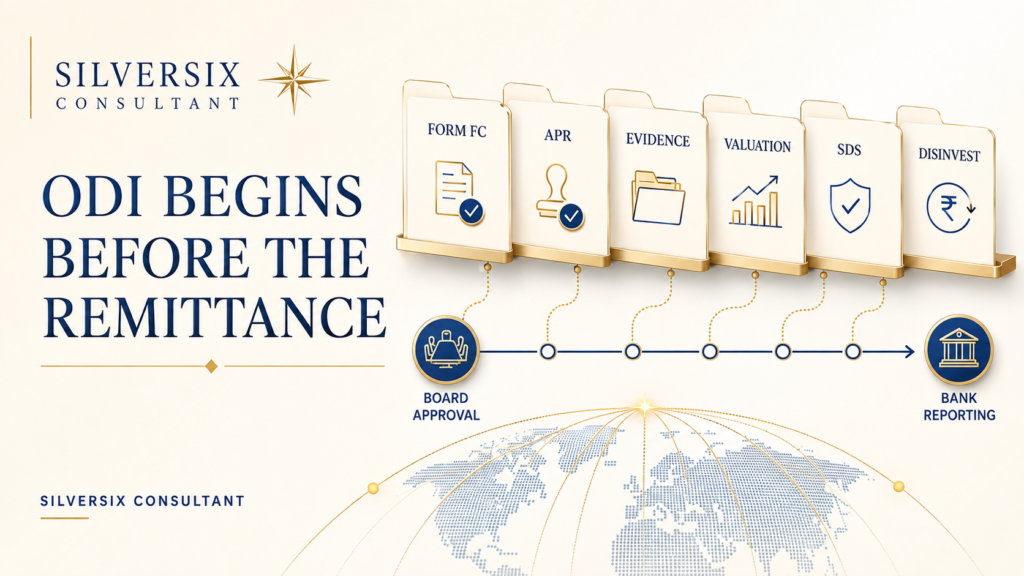
No money is transferred outside India. Does that mean FEMA and ODI compliance do not apply? Not necessarily. The common mistake is assuming that Overseas Direct Investment begins only when money leaves India. A foreign-equity acquisition, guarantee, share swap, capitalisation or non-cash transaction may create an overseas-investment event even when the outward remittance is […]
The NBFC Opportunity in India: A Strategic Guide for Entrepreneurs and Investors

India’s credit ecosystem is evolving rapidly. While banks continue to play a dominant role, Non-Banking Financial Companies (NBFCs) have emerged as a critical pillar of financial inclusion, specialized lending, and credit innovation. With increasing demand for unsecured loans, SME financing, loan against property, supply-chain financing, and digital lending, establishing an NBFC has become an attractive […]
Annual Performance Report (APR) Filing: The Complete RBI Compliance Guide

Every year, Indian businesses and resident individuals with overseas direct investments must meet a crucial Reserve Bank of India (RBI) compliance requirement: filing the Annual Performance Report (APR).The deadline is 31 December, and missing it can lead to penalties, blocked outward remittances, and FEMA contraventions. The APR is a mandatory annual disclosure filed in Form […]
RBI Widens Approval Scope for Cross-Border Mergers Under FEMA

🚨 Big Regulatory Update: RBI has amended FEMA Cross-Border Merger Regulations — and this changes the game for Indian M&A! The Reserve Bank of India (RBI) has notified the Foreign Exchange Management (Cross Border Merger) (Amendment) Regulations, 2026, introducing a landmark change in how cross-border mergers are approved in India. The amendment broadens the approval framework by replacing […]
India’s New Transfer Pricing Rules: What Every Multinational Needs to Know

India’s New Transfer Pricing Rules: What Every Multinational Needs to Know How the Income-tax Act, 2025 and the 2026 IT Rules are reshaping arm’s-length pricing, audits, and safe harbours — effective 1 April 2026. India’s transfer pricing (TP) regime has undergone its most sweeping overhaul in over two decades. Anchored in three instruments — […]
10 Reasons Indian Companies with Global Ambitions Choose SilverSix Consultant

The Cross-Border Advisory Landscape in 2026 Indian companies navigating cross-border investments, FEMA compliance, international tax, and corporate restructuring face a fundamental challenge: the advice they need is not available from a single traditional source. Large accounting firms may have the depth but not the agility or responsiveness. General practice CA firms may handle domestic compliance […]
Cross-Border M&A Due Diligence in India: The FEMA, Tax, and Regulatory Checklist for Acquirers
Why Cross-Border M&A Due Diligence Is Different In a domestic Indian M&A transaction, due diligence focuses on financial performance, legal title, litigation risk, and commercial contracts. In a cross-border M&A transaction — where the target has foreign investors, overseas subsidiaries, cross-border service arrangements, or international employees — the due diligence scope expands significantly to cover […]
Cross-Border Compliance for Indian Family Offices: What Every Wealthy Family Must Review in 2026
What Is FEMA Compounding? FEMA compounding is a mechanism under Section 15 of the Foreign Exchange Management Act, 1999, that allows a person who has contravened FEMA provisions to settle the violation by paying a compounding fee to the Reserve Bank of India — without facing adjudication or prosecution. It is the primary tool for […]
Cross-Border Mergers Under Section 234 of the Companies Act: A Complete Guide for 2026
India’s Cross-Border Merger Framework Section 234 of the Companies Act, 2013 (read with Rule 25A of the Companies (Compromises, Arrangements and Amalgamations) Rules, 2016) enables two categories of cross-border merger: inbound mergers where a foreign company merges into an Indian company (with the Indian company as the survivor), and outbound mergers where an Indian company […]
Transfer Pricing Safe Harbour Rules 2026: The IT Sector’s Biggest Compliance Opportunity
What Is Safe Harbour and Why Does It Matter? Transfer Pricing Safe Harbour Rules provide pre-determined profit margin benchmarks that, if met by the taxpayer, result in mandatory acceptance of the declared transfer price by the Indian income tax authorities — without any arm’s length price determination, detailed benchmarking study, or assessment scrutiny. In practical […]